More Workshoppery Storage

In the last article on Workshoppery Storage we got started on this vital work for the workshop to really be usable. The latest project is more storage for the workshop. Unfortunately, at the end of this project I’m at the point where I actually have plenty of storage and need to focus on organizing and storing everything into the storage…

Parts Cabinet

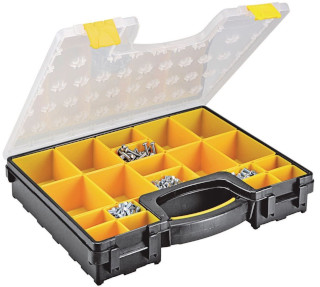
I’ve grown fond of storage cases – the cases of bins that are fantastic for storing nuts and bolts and similar small parts.

Parts storage case

Speaking of nuts and bolts, I’ve started buying them in bulk – quantities of 25-100 from places like Bolt Depot and by the pound from Tractor Supply. This is much cheaper than buying small quantities from the local hardware store or big box store. Each storage case is filled with a single size of bolt, like 1/4-20, in multiple lengths, as well as nuts and washers. It is surprisingly easy to fill up a storage case with a single size of bolt!

And the different types of fasteners accumulate: Bolts in 1/4-20, 5/16-18, 3/8-16, and 7/16-14. A collection of 3/8-16 bolts in Grade 8. How about 1/4-20, 5/16-18 and a few 3/8-16 bolts in Black Oxide? Can’t forget the Machine Screws in #6, #8, and #10. As well as a few machine screws in #12. Also can’t forget the assortment of sheet metal screws. And assorted special parts like fuses and adapters.

The result is eight or ten of the parts cases stacked on top of each other. The one you need is either in the middle of the stack or on the bottom, meaning that you have to play Tower of Hanoi to get the case you need. Many times you need two or three different sizes of bolts, meaning multiple chances to play the stacking game. You have to find someplace to put the case so that you can open it – and it seems that the case is always trying to fall on the floor and scatter bolts everywhere. Did I mention that I’ve overloaded most of the cases, so they have 12-15 pounds of bolts?

And, of course, I need more of these storage cases!

This lead to a set of requirements:

  • Store 20 of the parts cases.
  • Easy access to the parts cases.
  • Direct access to each case without moving any other cases.
  • A dedicated place to open the cases.

The obvious solution is a rack of shelves sized for the parts cases. I considered several alternatives. I really wanted to make it out of laser-cut steel with drawers for each case, but the cost was prohibitive.

The ultimate design was a cabinet frame made of 3/4″ plywood with 1/2″ plywood shelves sitting in routed grooves. Yes, this is overkill – but remember the overloaded cases. Five feet high supports exactly 20 parts cases and a set of casters let’s me put it wherever is convenient.

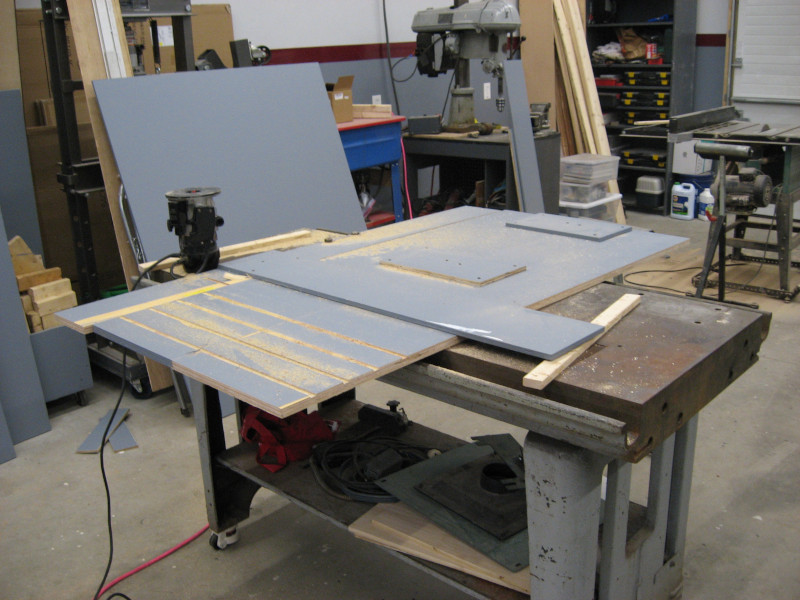
Routing 40 precisely measured grooves for the shelves was a considerable concern – until I realized that I could make a T-square jig out of scrap and bolt it to my work table.

Routing Jig for Parts Cabinet

The jig makes sure that everything is square and accurate. Screwing the two cabinet sides together ensures that they are aligned. An alignment mark on the side of the jig eliminates measurement – route a slot, pull out the cabinet sides until the routed slot aligns with the mark, route the next slot, and repeat until done. Easy and accurate!

After routing the grooves in the cabinet sides it was straightforward to assemble the cabinet, slide the shelves into place, attach casters to the bottom, and load up the parts cases.

I installed a pair of full extension drawer slides for one of the shelves, providing a pull-out shelf to place one of the storage cases on when getting parts out of it.

Parts Cabinet

The cabinet easily absorbed all of the parts cases I have. All that is left is to get more parts cases. And parts to go in them!

Cleanliness

Welding, grinding, painting, and woodwork all produce dust and grime that gets on everything. This is part of the reason all of the recent storage is closed – to try to keep the contents clean.

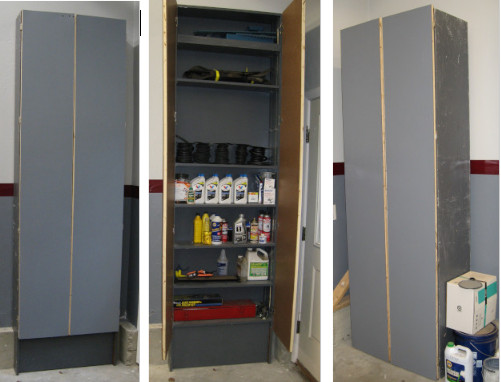
So it was time to add doors to the original storage cabinets. These are the two 8′ tall cabinets that were built several years ago – one shallow and one deep.

Old cabinets with doors

Next post: This Blows!

Next workshop/storage post: Yet More Workshoppery Storage

Posted in Workshop | Leave a comment

Workshoppery Storage

In the previous article on Workshoppery the workshop was insulated, sheetrocked, and painted. With the walls finished it was time to start on storage. Actually storage and organization – I need to not only store things but to be able to find them, to get to them during projects, and to easily return them to organized storage. Ongoing pain points included storage for large items, tool and supplies storage, and materials storage.

I also wanted a few luxury features: a good sound system and a computer that were protected from shop dust and grime.

The Big Cabinet

Big shelves and deep shelves are required for a lot of the tools, materials, and collections I have. However, big and deep shelves mean things shoved to the back where they are difficult to find and access. Plus open shelves allow shop dust and grime to get all over everything.

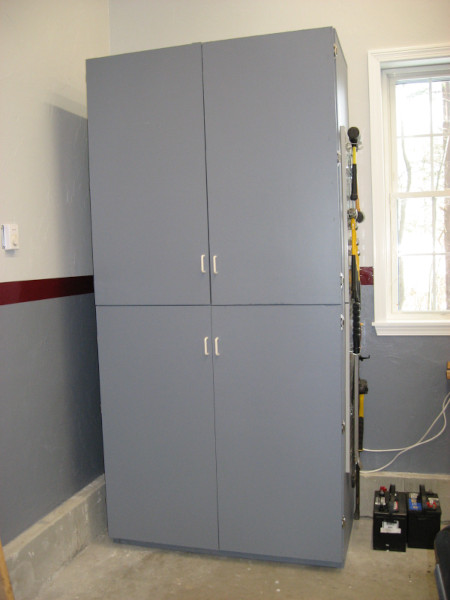
The answer is a big cabinet with half shelves and half drawers. Big means 8 feet high, 4 feet wide, and 2 feet deep. With doors!

Big Cabinet

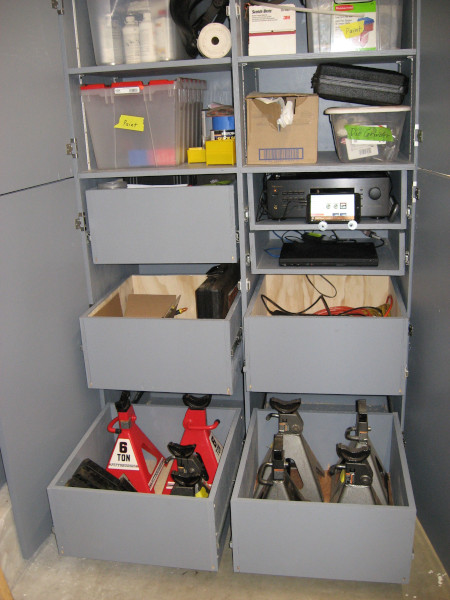
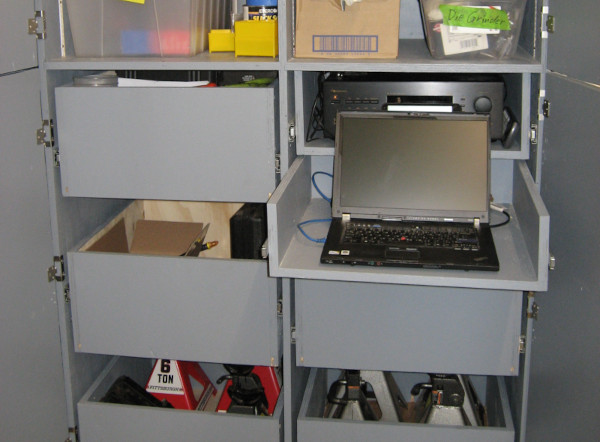
The bottom half is drawers and the top half is shelves. Two of the drawers are designed for stereo and laptop computer.

Big Cabinet showing drawers below and shelves above

This was the first time I had built drawers and was “a bit of a learning experience”… The cabinet and drawer sides are made of 3/4″ plywood. The drawer bottoms are 1/2” plywood set into routed grooves. This is probably overkill (hey, there’s a first time for everything!), but these will be heavily loaded. The drawers use full extension heavy duty slides, allowing them to be pulled out completely so that you can get to the back.

The jackstands in the botom drawers have been a nuisance for a long time – they are one of the reasons for building this cabinet. These jackstands weigh 15-20 lbs each. They are in the way, easy to trip over, and painful to kick. I can now get to them easily when I need them and store them out of the way when I don’t.

The laptop is in a pull-out drawer where it is easy to get to when needed and protected from the rest of the shop when not in use. The laptop is a 12 year old unit that still works fine for browsing the Internet and looking up things when needed.

Laptop in Big Cabinet

Building this cabinet was a big project but it turned out great – after fixing my various “learning experiences” along the way. Note that if a drawer slide is installed crooked in the cabinet, nothing you do to the drawer will make it fit any better…

Main Workbench

The goal is to have a Steevo Bench, which is named after a build thread on the Garage Journal website, with cabinets above. I’m part way there, so this is a snapshot.

Garage Journal is a truly evil website which has cost me quite a bit of money. Based on feedback of many people I decided that I wanted New Age Pro cabinets. The cabinets went on sale around Thanksgiving and four of the tall wall cabinets somehow showed up in my driveway. That’s not going to do anyone any good, so they needed to be moved to the wall!

I discovered that these are indeed high quality cabinets made out of heavy gauge steel. Which means that they weigh about 80 lbs. Each.

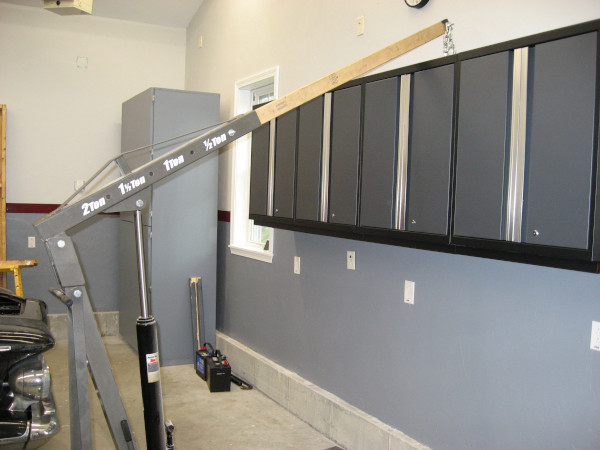
The good news is that they come with wall brackets that you bolt to studs, hang the cabinets from the brackets, and then bolt the cabinets themselves to the studs. I had already planned out this job, so I hung the cabinets from the handy engine hoist, raised them to the needed height, and observed the front legs of the hoist hit the wall while the cabinet was still a foot away.

The lifting point on an engine hoist is behind the front wheels. This is necessary to keep the back of the hoist from coming off the ground when lifting heavy objects. If you are lifting light objects you don’t need the hoist…

Time to add an extension to the hoist. Trying various available materials I discovered that a 2×3″ stud fit perfectly into the main tube of the hoist. Dig a 6′ piece of 2×3 out of the materials pile, bolt it to the hoist, and bolt the lifting hook from the hoist to the end of the stud. This worked perfectly to lift each cabinet to the needed height, position it, slip it over the brackets, and gently lower it into place.

Hoist with extension placing cabinets

The plan was to build a ten foot workbench with a 1/4″ steel top around two 44″ Harbor Freight tool cabinets. I had been waiting for the Black Friday sale to get the tool cabinets. Unfortunately they only had one in stock, so I now have one cabinet in the workshop and one cabinet on order.

Working up the parts list for the workbench I discovered that steel prices are quite high. Some research revealed that there is a major shortage of steel right now, causing near record high prices. Yes, another COVID-19 impact. Steel supply is expected to catch up with demand in the first quarter of 2021, so I decided to put off the workbench until prices go down.

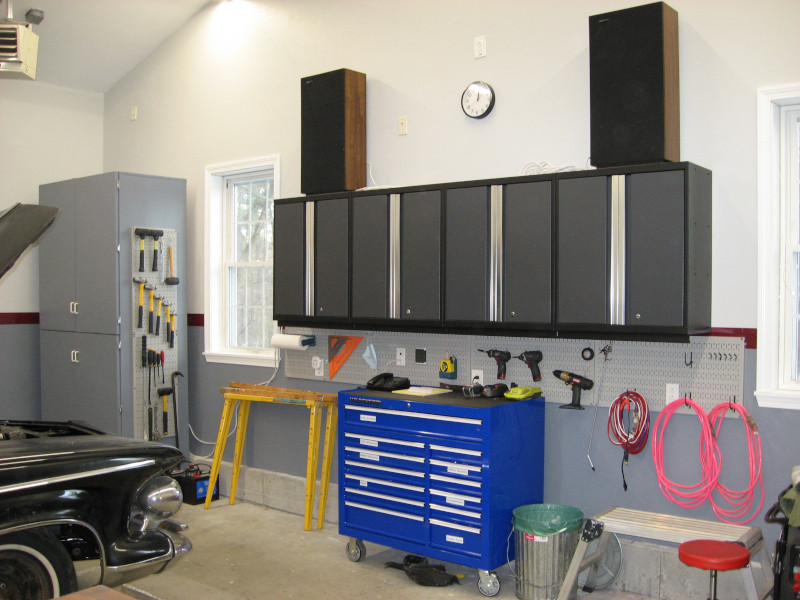
Another thing I wanted for the workbench was some pegboard on the wall – but I wanted something better than regular pegboard. Wall Control makes steel pegboard that looks good, so I ordered enough to go under the wall cabinets and on the big corner cabinet.

This brings us to where we are today:

Workbench in Progress

The speakers are some 35 year old Boston Acoustics A150s that had been in the basement for years. They sound great but were too big and had been replaced with smaller speakers. I had been brainstorming various types of wall mounts for them but then realized that these heavy duty cabinets will work just fine to hold them up.

The receiver shown in an earlier picture is an old Nakamichi AV8. It sounds great but became obsolete when HDMI replaced S-Video for TV equipment. It had also been in the basement for years. The tablet is an old HP tablet that supports Micro-SD cards – throw in a cheap 64GB SD card and it holds an entire music collection. No, the tablet wasn’t in the basement. It was in the bottom of a desk drawer. The result is a “free” workshop sound system with considerable authority.

Materials Storage

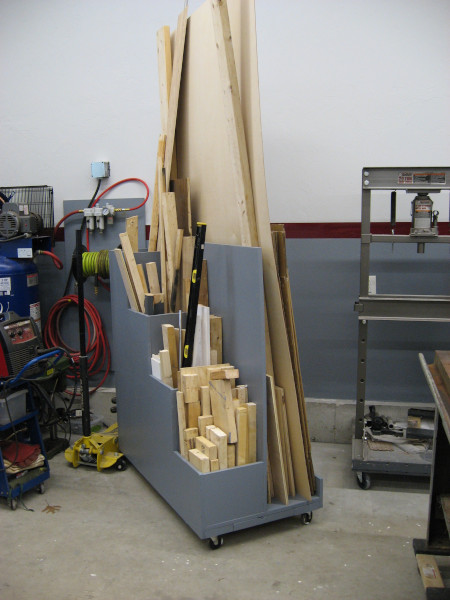
Materials storage ranging from 4′ x 8′ panels of plywood and steel to 8′ studs to shorter and smaller pieces of wood and metal has been an ongoing problem – they were scattered all over the place, piled in inconvenient places, and always in the way. One of the construction projects was to build storage for these.

Materials Storage Cart

This cart stores a wide range of material, rolls to where it is needed, and can be placed in an out of the way location. I’m no longer tripping over scrap, looking for pieces I might or might not have, or fighting large sheets!

Next: More Workshoppery Storage.

Posted in Workshop | Leave a comment

Workshoppery

It’s been a while since the last update. Further, there has been absolutely no progress on the car. Which is not to say there has been no progress!

You will recall regular whining every winter about the workshop being too cold. As well as whining about lack of storage and general complaints about organization and overall work environment.. And regular pronouncements of “I have to get this place insulated and sheetrocked!”. And organized. And generally cleaned up.

I was finally directed by She Who Must Be Obeyed to “just get some people to come in and get it done”.

The workshop was framed with 2×6, so we were looking at R19 insulation for the walls, R49 for the ceiling, and 5/8″ fire rated drywall. Yes, the workshop will end up better built and better insulated than the house. I asked the contractor who originally built the workshop for recommendations for good insulation and sheetrock people, called them, and got estimates. Expensive, but all the indications were that they could do a good job. Time to arrange a transfusion for the checkbook, schedule the work, and start Project Workshop Interior.

Unfortunately the first step in the project was to completely strip the workshop down to bare studs and empty it out. Everything had to come down off the walls. Everything had to be moved somewhere else – the garage, the shed, and the basement received most of the piles.

I scheduled two weeks for workshop cleanout and prep. By working long hours I actually managed to finish up the day before work was supposed to start! In addition to taking things out, the gable ends needed to be framed out to make the end walls flat from floor to ceiling. More CAT6 networking cable needed to be run – I ended up with 12 Ethernet ports in the workshop. This may be overkill, but it is convenient to have networking where you need it.

For organization, sanity, and being able to find things, the best place to store the Imperial parts was on the car – so the car had to go back together. Bumpers had to be installed, large quantities of trim had to be installed, the hood had to go back on, and various other parts and pieces had to be located and bolted back on. After all of this the car was backed out of the workshop and covered with a car cover for the duration of the project.

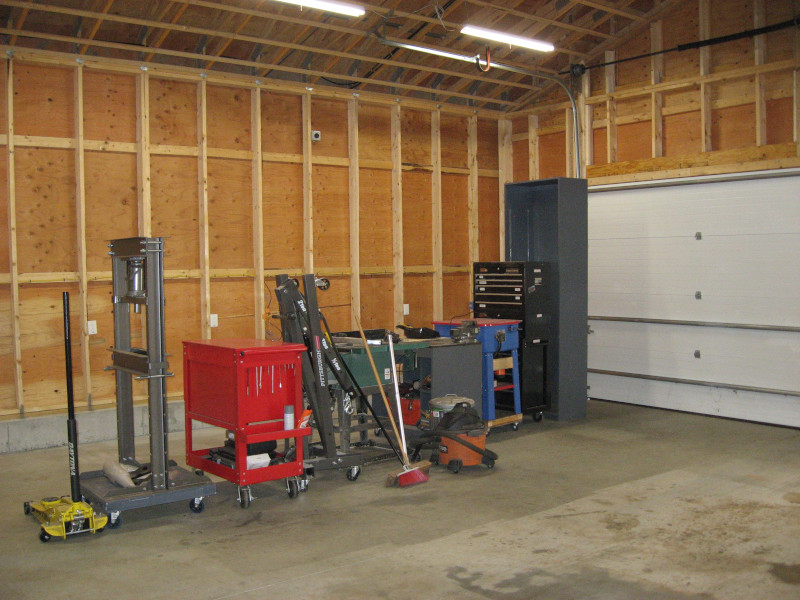
A number of things had to stay in the workshop. Fortunately these were on wheels so they could be moved around as needed by the construction crews.

Workshop Cleaned Up/Out and ready for insulation

The insulation crew filled the walls with Fiberglas insulation. They then added baffles between the soffit and the roof, stapled a cloth backer to the bottom of the roof trusses, and blew 15″ of cellulose insulation into the attic.

When the inspector showed up the conversation could have gone badly:

Inspector: “First of all, I see a bunch of new work electrical boxes but no electrical work on the permit”.

Me: “All the electrical work was on an earlier permit”.

Inspector, checking records online: “There is an electrical permit from July for a generator interlock but nothing about wiring”.

Me: “Check the one before that”.

Inspector: “OK, here is a permit from 2017 for electrical service, electrical panel, and general wiring of the workshop. It is completely signed off with rough and final inspections. Looks like you are good to go on the electrical”.

The sheetrock people told me that all of the lights and electrical covers had to be removed. The wall outlets weren’t bad, but taking down the lights from the 16 foot high cathedral ceiling was work. When the sheetrock crew showed up to drop off staging and supplies they told me that taking the covers off the electrical outlets was a good start, but that the actual outlet had to be removed from each box to allow them to cut out around the boxes for the sheetrock and to apply the plaster.

Of course I have 28 electrical outlets and 7 network outlets in the workshop. A long evening was spent removing all of these.

I’m always amazed at how fast a professional sheetrock crew is. Two people came in and did the entire workshop – a 28′ x 28′ building with 11′ high walls, 16′ cathedral ceiling, over 40 outlets of various types, with heavy 5/8″ drywall (120 lbs per sheet) – in ONE DAY!

Common practice in New England is to skim coat the walls with plaster rather than just mudding the seams. It took four days for the plaster team to finish. The final result was great – flat walls ready for paint. Well, after letting the plaster dry for 4-5 days…

Finished plaster walls with cutouts for 110V, 220V, and network. Some people think I have more outlets than are absolutely necessary. I don’t agree.

I got a quote for painting that was over 3X what it would cost me to do it myself. The quote was for 2 coats of white on the ceiling and 2 coats of off-white on the walls. I wanted something a bit nicer than that. And I wanted help with all of the high work on electrical, lighting, and heating.

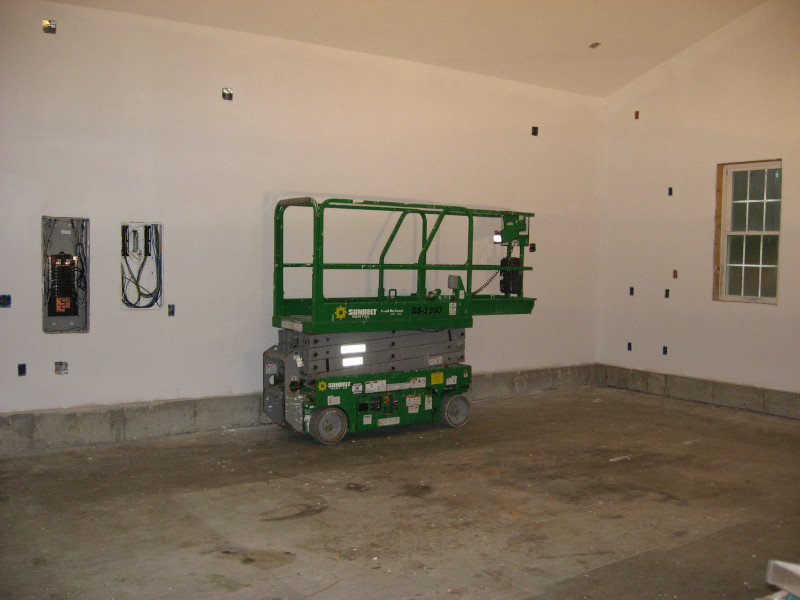
Step 1: rent a scissor lift.

Scissor Lift

This particular lift will go up to 19 feet tall, so it easily handles the 16′ cathedral ceiling in the workshop. The working platform is about 8′ long giving plenty of room to work. The lift goes to exactly the location and height needed, enabling you to paint huge areas in little time.

With the scissor lift in the workshop it was time to:

  • Apply 8 coats of paint (primer and two coats of Ceiling White to the ceiling, primer and two coats of light gray to the walls, and two coats of darker gray to the lower walls.
  • Re-install all of the electrical outlets, including the 7 in the ceiling.
  • Re-hang the 4′ LED shop lights. Upgrade from the original 10 lights to 16 lights making the shop much brighter.
  • Re-hang the ceiling fan.
  • Re-hang the heater from the ceiling.

This would have been almost impossible to do from a ladder. After this experience I will always get a lift for large jobs!

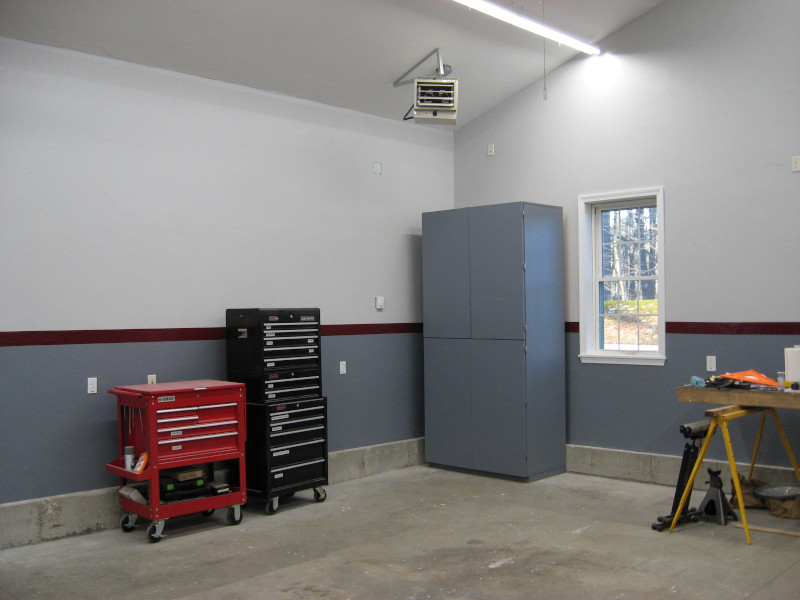
One other thing – I had seen pictures of two tone paint jobs with a red dividing stripe that look really sharp. It turns out that you can get vinyl stripes – the same vinyl used for outdoor signs – for $50 for a 100′ roll. These install quickly and easily, taking less than a half hour for all four walls.

Do the trim around the windows and the door and you end up with a finished workshop ready for for further customization.

Finished Workshop

I’m quite happy with how this turned out! More updates to come on storage, new equipment, and arranging an effective working environment.

Next: Workshoppery Storage

Posted in Workshop | Leave a comment

Electrical 4: Modernizing the Fusebox

In the Electrical 3: Bulkheading we replaced the factory connector with a new more modern design. Like the bulkhead connector, the fusebox under the dash is is old and crufty.

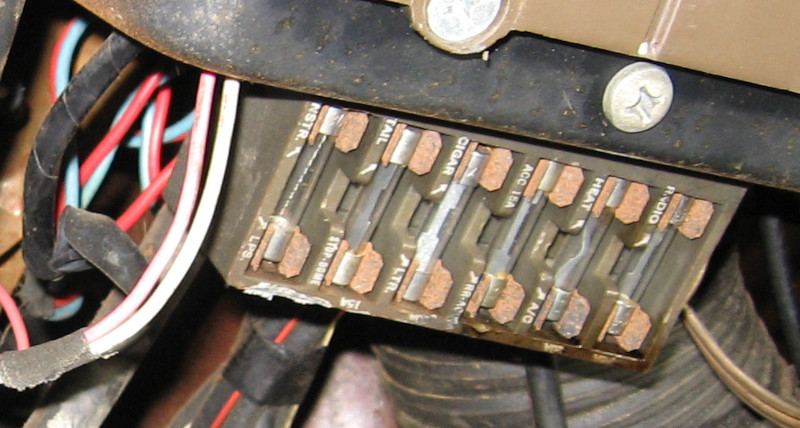
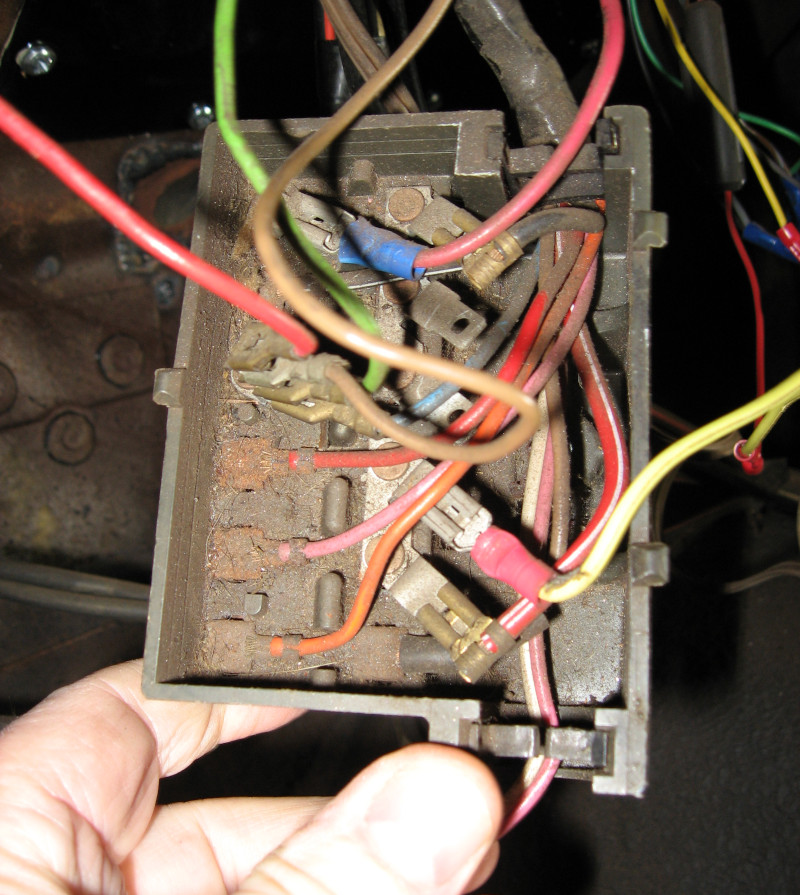
Old Fusebox
Old Fusebox rear view

In addition to rust and using old style glass fuses, this old fusebox only supports 6 circuits. This makes it difficult to add new electrical devices. In addition, some circuits are outside this fusebox. For example, the power windows and power seat are on a separate subsystem.

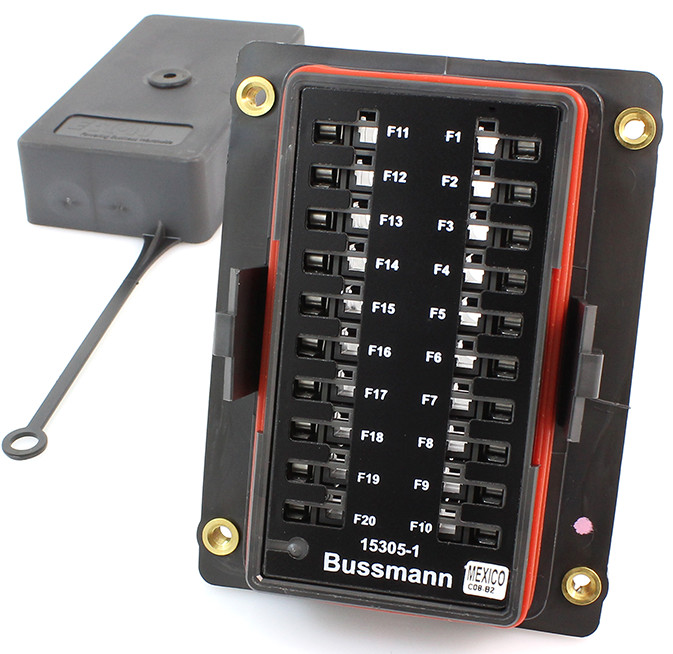
I’m replacing this with a Bussmann Series 15305-1 fuseblock. This includes dual power busses, space for 20 automotive fuses, and is designed for Metri-Pack 280 series connectors. An interesting aspect of the Metri-Pack 280 is that the connectors are the same size as automotive mini fuses. This means that automotive mini fuses can be plugged directly into Metri-Pack 280 female connectors. Using the Bussmann fuse block all you have to do is install a Metri-Pack connector onto the end of a wire and insert the wire into the fuse block and then you can plug in a fuse. Each power buss in the 15305 is capable of handling 100 amps and each fuse can be up to 30 amps.

Bussmann 15305 20 position Metri-Pack compatible fuse block

The power busses are connected to the new bulkhead connector described in a previous post. It is currently using the factory wiring configuration; ultimately each bus will be supplied by 3 wires and capable of delivering 60 amps of power.

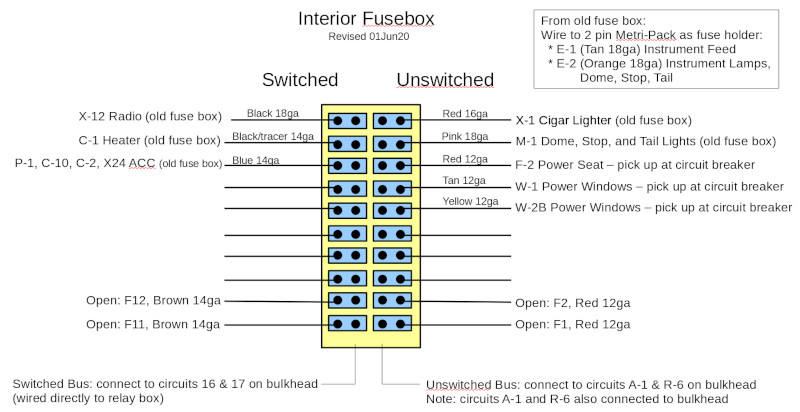
The process of wiring the new fuse block is the same as wiring the bulkhead connector: Start by building a diagram of circuits.

Interiof Fuseblock

Using this plan I then went through the process of cutting the wires, adding labels and new connectors, and then plugging into the new fuseblock.

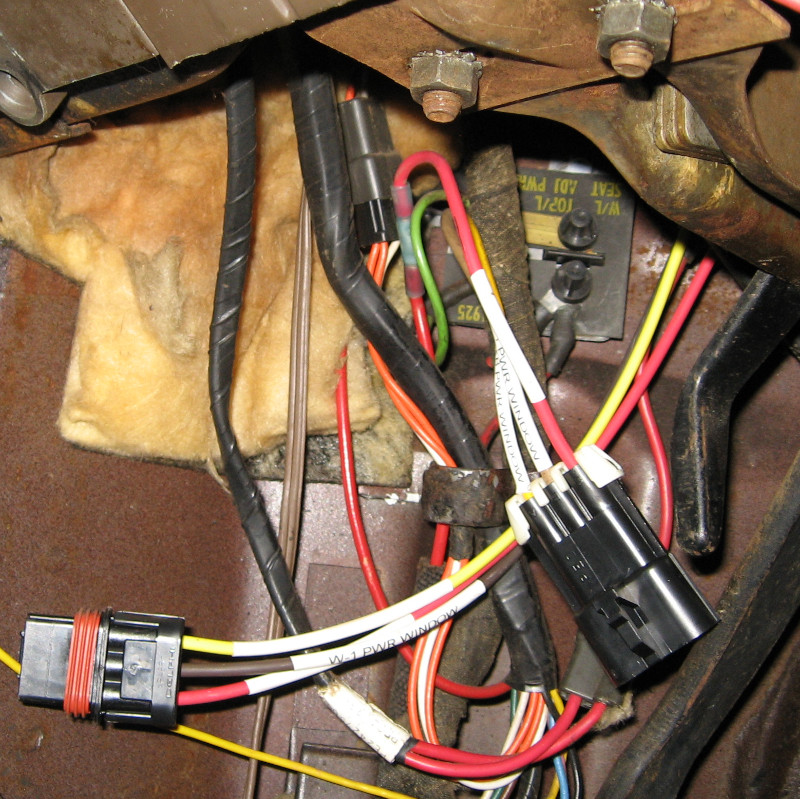
The power seat and power window wires were removed from the existing circuit breaker, terminated into a WeatherPack 3 circuit male connector, and three new 12ga lines were run from the new fuseblock (F-2, W-1, and W2B in the diagram above) to a WeatherPack 3 circuit female connector (shown here disconnected).

There are now plenty of extra circuits available. After connecting all of the factory wiring I added four additional circuits for future use. Each of these is 1′ long and has a Metri-Pack 280 series female connector installed. I can wire in new devices by putting a Metri-Pack connector on their power line, plugging it into one of the open wires, and adding the appropriate fuse. This avoids having to remove the fuseblock to get to the back side to add a new circuit.

If needed I can add an additional seven switched devices and five unswitched devices – this should provide plenty of expansion capability!

There was one special case: the instrument cluster lighting is on a dimmer circuit which changes voltage – this circuit can’t be connected directly to a power bus. I connected each side of the instrument cluster lighting to a Metri-Pack 280 series female connector and plugged in the specified 1 amp fuse. It is really convenient building fused circuits using the Metri-Pack system.

Next: something a bit different with Workshoppery.

Next electrical: Electrical 5: Boxing

Posted in Restoration | 2 Comments

Electrical 3: Bulkheading

In the previous article Electrical 2: Grounded we started the electrical work with perhaps the most overlooked part of automotive wiring.

Perhaps the greatest weakness in the electrical system of older cars is the bulkhead connector that connects the engine compartment to the rest of the car. Unlike modern bulkhead connectors, these old connectors were not sealed – this leads to corrosion in the connector which increases resistance, reduces voltage, and leads to a wide range of problems.

The problem is made even worse by undersized wiring which is also corroding and likely to have cracking insulation.

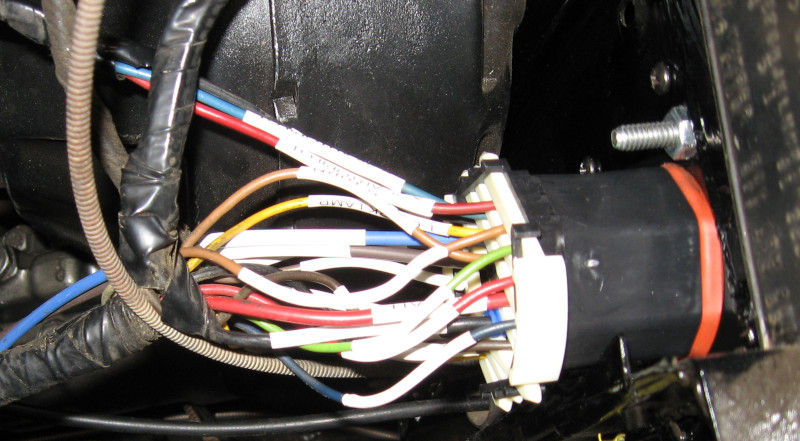
Imperial bulkhead connector
Bulkhead with connector unplugged

In this second picture you can see the corrosion inside the bulkhead connector. Surprisingly the wiring insulation is still in good shape. The red and black wires are power and ground and are 12ga – this is marginal for today’s electrical loads.

Modern cars use waterproof sealed electrical connections. Examples of this include Weather-Pack, Metri-Pack, and Deutsch. I decided to use Metri-Pack and Weather-Pack which are widely available and “reasonable” cost.

Weather-Pack connectors are rated at 20 amps. Different models of Metri-Pack are rated at 14 to 60 amps per connector; I’m using the Metri-Pack 280 family, which is rated at 30 amps per connector. Unfortunately Metri-Pack is not available in high pin count bulkhead connectors.

The best choice is the Weather-Pack 22 Position Bulkhead Connector. This is a sealed bulkhead connector that supports 22 connections. Using an adapter plate it fits into the same space as the factory bulkhead connector, meaning that it isn’t necessary to cut the firewall.

Weather-Pack 22 Position Sealed Bulkhead Connector

As mentioned, the Weather-Pack connections are only good for 20 amps. I really need more power than this. The factory bulkhead connector only has 18 connections – this means 4 connections are available for other use.

I will be using two of these to provide switched power and two to provide unswitched. Combined with the factory circuits (one for switched and one for unswitched) this will give me three 20 amp circuits – which provides 60 amps total power delivery – for both switched and unswitched power.

Installing the Weather-Pack bulkhead connector was a tedious process. For each wire:

  • Identify wire and circuit. Cross check terminal location and wire color against factory service manual.
  • Double check identity of wire and circuit.
  • Create 2 labels for wire. This identifies the circuit and use.
  • Cut wire from the old bulkhead connector.
  • Slip label over wire.
  • Slip Weather-Pack seal over wire.
  • Strip end of wire.
  • Crimp Weather-Pack terminal onto wire.
  • Use heat gun to shrink the label.
  • Move on to next wire

At the end of this process you have 44 wires ready to plug into the connector shells. It is critical to get the same wire plugged into both sides of the connector – crossing wires is a bad thing. To make it more entertaining the two halves of the connector are done separately and are mirror images of each other.

The way to avoid problems is to have a map of the connectors showing where each wire goes. A spreadsheet is a surprisingly good tool for this.

Start by listing all of the circuits on the factory bulkhead connector. Include connector pin location, circuit number, wire color, and wire size. Also include a description of the circuit. Looking forward, plan which pin location on the Weather-Pack connector will be used.

Bulkhead Connector Wiring Diagram

Spreadsheets are square and the Weather-Pack bulkhead connector is round. The answer is to visually map spreadsheet cells to the round bulkhead. In fact, do this twice – once for both male and female connectors.

Weather-Pack Bulkhead Connector Pin Map

This map shows the location of each pin and the identity of each pin – each pin is identified by a letter which is the same on both the male and female connectors. Each wire is labled with the circuit number and description.

The process is to start at the bottom of the connector, find the wire that goes in that location, and insert it into the connector until it locks into place. Then find the next wire and insert it. Double check to ensure that you have the right wire and the right pin location. Continue this process until you have plugged in all of the wires.

After completing the first connector do the same thing on the other connector – making sure you are using the correct diagram, male or female!

At the end of this process you will have a new sealed bulkhead connector installed in the firewall with all circuits labeled.

Weather-Pack Bulkhead Connector Installed

Next: Electrical 4: Modernizing the Fusebox

Posted in Restoration | Leave a comment

Electrical 2: Grounded

The first article Electrical 1: Shocking Developments introduced our strategy for upgrading the electrical system. Time to get to work implementing that strategy!

As Captain Obvious has observed, electrical systems consist of two parts: power and ground. While power is obvious (pun intended), ground is often an afterthought. This makes the ground system a logical place to start for building a reliable electrical system.

The challenge with ground is that it uses the body and frame to provide an electrical path, often with poor connections. These connections are barely adequate when new and degrade over time. The battery ground is connected to the engine block, providing high current power to the starter. The engine block is then connected to the firewall with a single ground wire and a small screw. Various electrical components around the car are then grounded to the body.

Several months ago, as part of general preparation, I welded two bolts to the frame – one near the firewall ground point and one near the battery. This provides solid electrical connections to the frame with no chance of corrosion, making a high quality ground available to the entire car.

I then had two heavy duty ground wires custom made by GenuinedealZ. These ground wires were made from 4 gauge (4ga) tin-plated solid copper wire with heavy duty terminals and adhesive lined heat shrink tubing. What does all this mean?

Solid copper wire is a better conductor and stronger than aluminum or copper coated aluminum (CCA) wire. Low cost wiring is often CCA, which doesn’t hold up under severe service. Since copper wire by itself can corrode, a tin coating is used where it is likely to get wet. Tin coated wire is often called marine grade as it holds up to the harsh conditions encountered in marine use. Areas of a car that are exposed to moisture, such as under hood use, are good places to use marine grade wire.

Factory ground wires are often 12ga or perhaps 10ga if you are lucky, which was adequate in the 1960’s. As a point of comparison, 4ga wire was often used for the high current starter. When ordering these custom cables the cost difference between 8ga and 4ga is less than $1.00 per foot, so it makes sense to upgrade.

Heavy duty terminals, also made of tin coated copper, are sized for their application. In this case I have 1/4″ bolts for the frame ground and firewall ground and 3/8″ bolts for connecting to the engine block. One cable goes from the frame ground to the firewall bolt and the other goes from the firewall bolt to the engine block.

Sealing electrical components from moisture is a key to long life. Heat shrink tubing provides mechanical and electrical connection. Adhesive lined heat shrink tubing has a heat sensitive glue on the inside. When heated this adhesive melts and forms a waterproof bond. Adhesive lined heat shrink tubing is the standard for marine applications and is great for automotive applications.

The screw connecting the original ground wire to the firewall has been replaced by a 1/4″ bolt through the firewall. The firewall was sanded clean around the bolt hole for a good electrical connection, then the bolt was run through the two new grounding wires. After this the area around the bolt was sealed. Inside the car a 10ga grounding wire was attached to the bolt – this wire will be attached to a grounding block under the dash.

A dedicated ground line was run from the negative terminal of the battery to the other grounding bolt on the frame. This is currently a 10ga wire – it will be upgraded to a 4ga wire the next time I order custom cables. This grounding point will also be used by the power distribution box planned for high current loads like headlights.

The net result of all of this is a very solid ground system to support the rest of the electrical system. The existing body ground has been improved, which will help in general. Solid electrical connections of the body to the frame, engine block, and battery negative terminal will eliminate many potential problems. Using grounding blocks and dedicated ground wires for high current use cases will further improve electrical performance.

While not as exciting as other work, starting with the grounding system is key to electrical success.

Next: Electrical 3: Bulkheading

Posted in Restoration | 2 Comments

Electrical 1: Shocking Developments

One of the biggest weaknesses in older cars is the electrical system. These were typically marginal from the factory and don’t age well. Marginal size of wire, corrosion in connectors, switches, and wire, and 50 year old insulation all combine into a lurking dragon waiting to pounce at the worst possible time.

It is easy to find horror stories about melted connectors, burnt wiring, dash fires, and engine fires in old cars. Plus the reliability problems of things simply not working or not working well.

In addition to the steady weakening of the electrical system as it ages, demand for power increases. Traditional headlights have been replaced with high power quartz headlights. Radios have been replaced with infotainment systems – a modern infotainment system with a big amp can require more power than the entire car did in 1963! In addition there are more electrical devices in use today than 50 years ago.

I’ve really gotten used to the headlights in modern cars. I’m reaching the point of “enhanced maturity” where I don’t see as well at night as I used to, and powerful headlights are more a necessity than a luxury. The original headlights in the Imperial look like they are using actual candles!

The Imperial came with a 35 amp alternator; air conditioned cars like mine were upgraded at the factory to a “high capacity” 40 amp alternator. In comparison, modern cars have 100+ amp alternators with many exceeding 200 amps.

Fortunately something can be done about this!

I’m using two main references: first is a set of tutorials on the Bodenzord website going into great detail on how to build a modern wiring system. These tutorials are superb and have cost me a lot of money in parts and tools.

The second is Daniel Stern Lighting which provides a lot of insight into upgrading lighting systems. This site is complementary to the Bodenzord site and makes clear the importance of wire size, relays, grounding, and headlight and bulb selection.

These two sites educated and inspired me to plan significant upgrades to the Imperial wiring, including:

  • Think about and design a set of modifications and improvements to the electrical system.
  • Upgrade the factory under-dash fuseblock to a modern fuseblock. The original fuseblock contained six glass fuses. The new fuseblock has 20 ATC Mini fuses on two separate buses – 10 switched/accessory and 10 unswitched/always on. Each bus is driven with 40 amps of power through new wiring.
  • Bypass the ammeter. This is perhaps the greatest weakness of old Mopars – the entire electrical load is routed through a gauge in the instrument cluster. I’m bypassing the ammeter and routing most loads through new wiring. The only downside is that the ammeter no longer shows charging status. I will be adding a voltage meter as part of the upgrades – voltage meters are actually more useful in determining what is going on with the electrics.
  • Changing how power is delivered from the alternator and battery to the rest of the electrical system.
  • Upgrading the firewall bulkhead connector to a modern waterproof design.
  • Adding a new under-hood fuse and relay block.
  • Moving heavy loads like headlights from the factory wiring to new wiring.
  • Moving all heavy loads from switches to switch/relay configurations.
  • Installing new upgraded wiring for major circuits – typically one to two sizes heavier wire for each circuit.
  • Redesigning the alternator circuit with larger 60 amp alternator, heavier wiring (go from 12ga to 6ga), and a solid state voltage regulator.
  • Upgrading the grounding system. Many electrical problems, especially in older cars, are due to poor grounds. The grounds are just as important as power!
  • Labeling everything to simplify troubleshooting and to help me when I have to work on something in a couple of years.

Next: Electrical 2: Grounded

Posted in Restoration | 3 Comments

Around the Block!

With the engine running and the transmission adjusted it was time to drive the car!

The first step, of course, was to back it out of the workshop – for the first time in 3 years! And then back and fill several times to make sure things were working – engine, transmission, steering, brakes, suspension.

The results were a bit mixed. The engine was running rough, the brakes needed further bleeding and adjustment, and the ride height needed adjustment. The steering felt fine, and the front end was much tighter with all new parts.

After bleeding and adjusting the brakes I had a high, firm pedal – but no power boost. The brakes seem to be working, but require excessive pedal pressure. This is obviously not acceptable for any real driving. Need to check the vacuum to the power brake booster and see if there are any other problems.

I decided that it was running well enough to drive it around the block. I made it around the block, but the engine wasn’t running right.

Over the next few days I made a series of adjustments and several more trips around the block. It is better, but still not good. The frustrating thing is that the engine starts instantly when you turn the key, but is running rough. Need to do more tuning of both carburetor and ignition.

The front suspension needs work. I set the front ride height using the torsion bar adjusters. After driving around the block the front end had settled significantly and was now resting on the bump stops. I did several more cycles of adjust and drive, getting the adjustments better but still not where they need to be.

Hopefully this is just the torsion bars settling. If not, it could be the threads in the torsion bar adjuster stripping out. Hopefully this isn’t the case, as these adjusters are no longer available! I had cleaned and checked the threads when I had the front end apart and they seemed fine. More work is needed here.

It is a huge step forward to have the Imperial running and driving, but more work is needed before it is roadworthy.

Next: Electrical 1: Shocking Developments

Posted in Restoration | Leave a comment

Shifty Buttons

At the end of the last article, the engine was running but the car was starting with the transmission in gear. At first this was noticeable but not a major problem. However, after the transmission was filled with fluid so that the torque converter could properly work it rapidly became a safety issue.

This shouldn’t have been a problem – one of the improvements of the 1963 Imperial is a parking lock that locks the transmission so that it can’t move when placed into Park. Unfortunately the locking mechanism wasn’t engaging. So, there were two problems:

  1. The transmission linkage was not properly adjusted – the transmission was actually in Drive with Neutral was selected.
  2. The transmission parking lock was not engaging.

In 1963 Chrysler used pushbuttons to actuate a cable to control the transmission. The tip of the cable engages a locking mechanism inside the transmission and then is adjusted by a threaded nut on the cable sleeve.

Pushbutton Transmission with Parking Lock Lever on Left

Of course this adjustment is located in the middle of the two transmission cooler lines, exhaust headpipe, torsion bar, and nestles in the transmission hump in the floor which barely clears the transmission. In other words, almost impossible to get to!

I had done the initial adjustment before installing the exhaust and transmission cooler lines. It was difficult but not that bad. Unfortunately, even though I followed the manual, the initial adjustment was incorrect.

Bare Transmission

I hadn’t mentioned in in the previous post, but an additional problem was that the Neutral Safety Switch wasn’t engaging, so I had to jumper around this safety feature to get the starter to work.

Some Internet research detailed an approach of putting a multimeter on the Neutral Safety Switch, setting the adjustment wheel to the point where the switch just turned on, and then continue to adjust it while counting turns until the switch just turned off. At this point you back the adjuster off half the number of turns you counted, placing it right in the middle of the switch range.

This was a nightmare to do, between the lack of access to the cable fitting, working under the car, and the joy of transmission fluid dripping down your arms as you work. And, of course, the dripping transmission fluid making everything slippery and hard to adjust!

Shift Cable with cooling lines, parking brake, and exhaust installed

It was finally done. Surprisingly with no bloodshed, damaged parts, or flying tools!

The parking lock is a separate cable. This should be easy – slide the cable into the transmission and the tip automatically locks into place. Put the transmission lever into park, adjust the cable so that the pawl engages, and tighten the bolt to lock it into place.

Except that no matter what I tried the cable tip would not lock into place! I spent hours trying everything I could think of with absolutely no success. This included following the instructions in the manual as well as suggestions from various Imperial and Mopar forums. It got to the point where I had to put the tools down and walk away before bad things happened.

I had a couple of rounds of email asking for help from Don Verity who had rebuilt the transmission. He finally suggested partially disassembling the transmission so that I could see the locking mechanism and make sure that the cable tip was properly engaging with it.

This proved to be the magic answer. Once I could see the locking mechanism I was able to guide the cable tip into it and lock it into place. With a little fiddling I managed to get the rest of the pieces back into place and bolt everything back together. I still don’t know what the problem was – it should have “just worked”!

OK, now to follow the parking lock adjustment instructions again. Hmm, so THAT is what it feels like when the locking pawl engages. Try to turn the drive shaft – nope, locked solid! Move the parking lever to drive and the driveshaft turns. Looking good! Cross fingers, move the parking lever back to park, and try to turn the drive shaft. Locked again. Success!

Now for the real test. The car is up on jack stands, so the rear wheels can turn freely. Put the transmission in neutral with the lever in park. The engine starts up – a “good start”! The rear wheels are locked and don’t move.

Next step is to put the parking lever in the off position while leaving the selector button in neutral. If the transmission linkage is properly adjusted the rear wheels will not move. And they don’t move! Rev the engine a little, and the rear wheels still don’t move. Looking good…

Cross fingers and punch the Reverse button. A bit of a clunk from the transmission, and the rear wheels begin to rotate. Looking even better!

Step on the brakes to stop the rear wheels and then punch the Drive button. The wheels begin to rotate the other way.

Now to try various combinations of Park, Neutral, Drive, and Reverse. The transmission continues to function properly.

And there was much rejoicing!

With the engine running and the transmission properly adjusted it is getting close to time for a maiden voyage.

Next: Around the Block!

Posted in Restoration | Leave a comment

The Mighty 413 Roars to Life!

Saturday August 9 2020 is one of the highlights of the build – the Mighty 413 engine started and ran!

It wasn’t easy. The engine fought us every step of the way. But it finally ran!

After installing the exhaust (documented in I’m Exhausted!) it was time to install the battery and starter relay, fill with fluids, and call a friend to help.

The starter relay, voltage regulator, and battery box are all bolted to the inner fenderwell.So, the left and right inner fenderwells were installed, the brackets for the battery box were finally figured out (I continue to be thankful I’ve taken so many pictures), and the rest of the electrical wiring was roughly routed.

Front End with battery and electrical

It was now time to add fluids. Barely visible in the picture above is a fluids checklist taped to the windshield. I recorded each fluid as I added it: oil, water, power steering fluid, transmission fluid, gasoline, and rear end lube.

You might think this is overkill. I disagree. It is way too easy to skip a step in the excitement of starting the engine for the first time. And it is very expensive to start an engine without oil!

It is also easy to overlook partial fills. For example, the transmission holds 9 quarts of ATF (Automatic Transmission Fluid), but you can only add about 6 quarts initially before it overflows the transmission. ATF must be pumped into the torque converter by a running engine before you can add the rest. A checklist helps you keep track of this.

After double checking everything it was time to turn the key.

The engine spun over nicely, thanks to the largest battery I could find. This battery is rated at 1050 amps of cranking power, where most batteries are 400-700 amps.

An initial “burp” from the carburetor got our hopes up. Then… Nothing.

We couldn’t get the engine to start. When this happens the problem can be compression, spark, or fuel.

Compression is good – this is a brand new engine.

Fuel is good. The clear plastic fuel filter quickly filled with gas, showing that the fuel pump was good. Pressing the gas pedal produced a strong stream of gas from the accelerator pump in the carburetor. And we were spraying starting fluid, which would run the engine for a few seconds even if the carburetor was completely broken.

Spark was good. We verified spark with the timing light, even checking several different plug wires. We pulled a spark plug and grounded it against the block, where we could directly observe a strong spark. The timing light showed that it was firing within 5 degrees of Top Dead Center, which is more than close enough to start. The engine might run a little rough, but it would start.

We tried everything we could think of. Then we tried some more things!

We thought the distributor might have been installed 180 degrees out of phase, so we reversed it. The distributor can be installed at Top Dead Center (TDC) on the compression stroke or the exhaust stroke; it has to be at TDC on the compression stroke to run. No change, so we put it back in the original configuration. As a side note, when installing the distributor I had turned the engine over with a big ratchet and socket to align the timing marks on TDC. I held my thumb over the #1 spark plug hole to detect compression, but might have gotten it wrong – the odds were 50%/50%.

I had originally installed a set of Bosch Platinum spark plugs which were listed for this car in a current parts catalog. I had read somewhere on the Internet that old ignition systems don’t work well with the new style plugs, so we made a parts store run for the original factory specified Champion J-9Y spark plugs and installed them. Still nothing.

We had earlier noticed the point gap was somewhat tight. Within specs, but still tight. So we re-adjusted the points to a gap of 0.018″, which is towards the high end of the spec. Still nothing.

We pulled a spark plug again and discovered that it was wet with gas. Our repeated efforts to start the engine had flooded it! The cure for this is to let the engine sit for a few hours and give the gas in the cylinders a chance to evaporate.

As my friend prepared to leave and arranged to come back in 3-4 hours to try again we slapped a battery charger on the battery. To our surprise even after 4 hours of repeatedly cranking a big block engine for extended periods of time the battery still had a 70% charge. This battery is indeed a monster!

We decided to crank the engine one last time before he left.

BANG! went a loud explosion from the exhaust! Not only had the gasoline been exhausted from the cylinders, it had also been ignited. We looked at each other, saying “just a minute – isn’t a backfire like that a sign that that the distributor is 180 degrees out?” In other words, a sign that the distributor is installed backwards.

Once again we eased the distributor slightly out the block, rotated the distributor shaft 180 degrees, and re-seated it.

Once again we turned the key and engaged the starter. This time, to our delight, the engine caught and ran for a few seconds!

We restarted it a few more times, tweaking the distributor and working the throttle. It started and died several times and then caught and continued to run!

We let it run for a few minutes and then shut it off and did a fluids check. As expected, all of the fluids needed to be topped off.

We started it again, and it easily started. We discovered that it wanted to roll forward – even though the transmission selector was in neutral the car was starting with the transmission in gear. Clearly the transmission selector needs to be adjusted before we can run the engine longer.

It was time to shut things down for the day, high-five each other in celebration, and leave the workshop on a high note. Much more work remains to be done, but this was a HUGE step forward!

Our analysis is that we were dealing with a combination of things: the distributor being installed backwards was the main problem, exacerbated by tight point gap, inappropriate spark plugs, and a flooded engine. We basically had to work through all of these before achieving success.

The next step is to get the transmission adjusted, dial in the ignition and carburetor, and then move on to the remaining assembly tasks.

Next: Shifty Buttons.

Posted in Restoration | Leave a comment