Site Move? Site Move!

The site has moved from imperialjourneyblog.wordpress.com to imperialjourney.org. What does this mean? All in all, not much.

I started this blog using free hosting from WordPress.com. This was an easy and, umm, free, way to get started. The only real downside was the somewhat ugly site name.

It looks like I’m going to keep updating this blog, and I had registered the domain imperialjourney.org, so I finally decided that it was past time and migrated the site. I now have the flexibility to make more changes to the site if I want to – but probably won’t actually change anything.

Join me here at the new and not especially improved imperialjourney.org for the same wonderful content you have come to know and love: semi-irregular updates on “progress”, reports on doing things the hard way, general whining, and the ongoing adventures in my little corner of the universe!

Posted in Misc | Leave a comment

Yet More Workshoppery Storage

Much of the work on the Imperial is on hold while waiting for the power brake booster mentioned in the last post. The next round of planned electrical upgrades are a tight fit to the brake master cylinder, so I’m holding off on that work until the power booster and master cylinder are back in place.

That means now is a good time for some more workshop organization! Getting things off the floor and out of the way is vital. One of the secrets is to put shelves over other things. Large shelves. Multiple shelves.

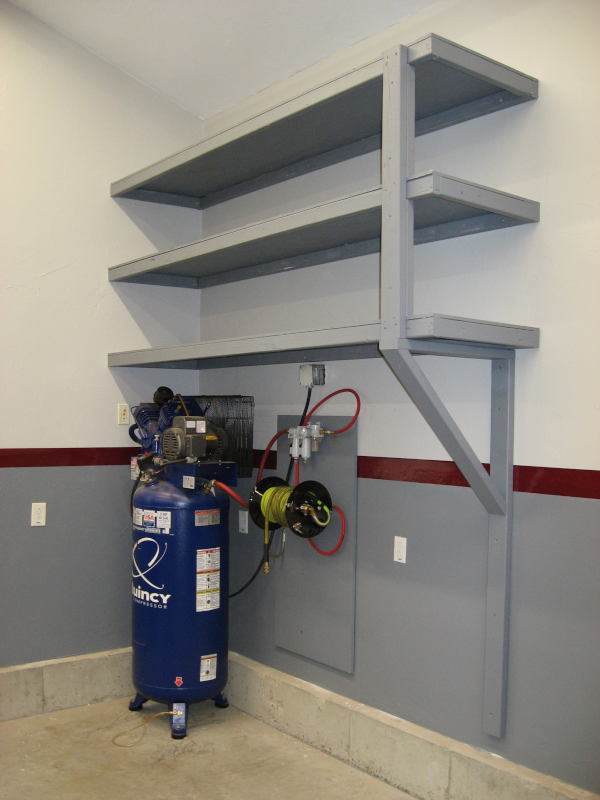
Which is exactly what I had back before the workshop was gutted for insulation and sheetrock – a set of three shelves over the air compressor. These shelves were not only missing from their mission of providing useful storage, they were sitting on the floor and actually part of the problem!

Time to give them the usual three coats of paint and stick them back up on the wall. Note the triangular corner brace to avoid having a leg going to the floor. This minimizes the impact of the shelves.

Corner Shelves

This is the only time this corner will be this clean. Shortly after this picture was taken there were things on, under, beside, and around the shelves – just as intended!

Posted in Workshop | Leave a comment

Two Steps Forward. One Step Back. 1/2 Step Forward?

After the Not a Good Day things seemed to be improving. In Tanks A Lot it even looked like the gas gauge was working!

I called Power Brake Booster Exchange who had rebuilt the (wait for it…) power brake booster and described what I was seeing with the brakes. Their verdict was “sounds like something inside the booster isn’t right; send it back and we will take a look”.

So I did and they did.

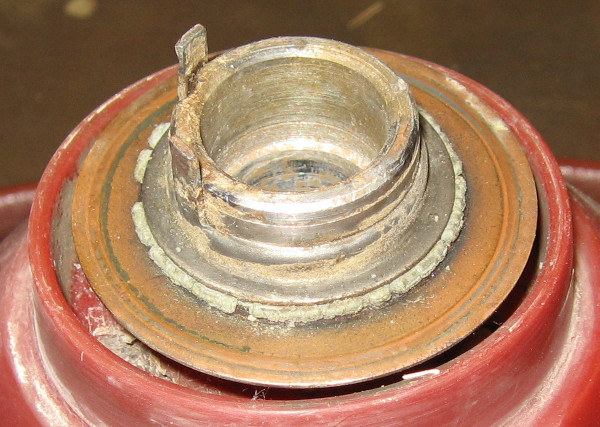
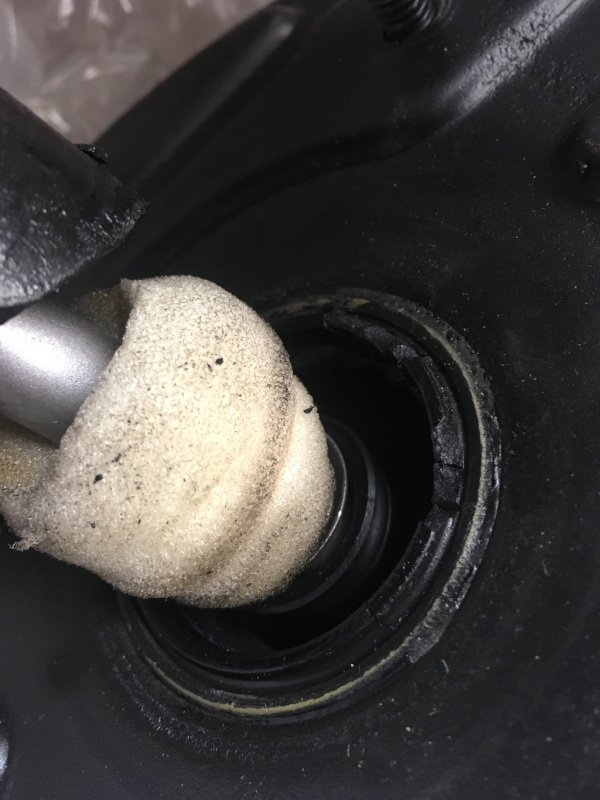
And then I got the email. With pictures. The main hub is broken, not repairable, they don’t have any of these boosters and they don’t have any parts.

Broken main hub on power brake booster

The main hub is a plastic piece. A 60 year old plastic piece. That is fairly easy to break in shipping unless the brake booster is packed very carefully. Now I learn this…

OK, time to find a replacement. I went through my list of usual suspects for Imperial parts and got the same response across the board. “No, I don’t have any. These are really popular and hard to come by. They go really fast when I do get one.”

Krud. On a stick. With a side of rancid krud! Brakes are kind of necessary on a car. I’m rapidly moving back to a not so good day.

I posted a note asking for help on the Online Imperial Club mailing list. Someone suggested trying Murray B. Park, so I gave him a call.

He said that he didn’t have a ready to install booster, but he did have a rebuildable core. I grabbed that while I had the chance and asked him to ship it directly to Power Brake Booster Exchange. Apparently this isn’t the first time he has done this. He claims to know how to pack things so that UPS can’t break them. I pointed out that this is a rather bold claim. He acknowledged that I had a point…

Things are looking better than they did yesterday. This is a half step forward. As soon as I have a working booster installed in the car it will be a full step forward.

In the meantime I’m sitting here muttering under my breath “It’s only money. It’s only money. It’s only money. “

While waiting for (hopefully) good news on the brake booster let’s take some time for Yet More Workshoppery Storage. Or go straight to the next restoration article Chilling?.

Posted in Restoration | Leave a comment

Tanks A Lot

After installing the New Speedometer Cable! in the previous post it was time to move to the next item.

Despite having a new sender the gas gauge still doesn’t work – it remains on empty. There might be a problem with the gauge, the sender, the wiring – or the tank might actually be empty. After all, this is a new gas tank that has never had more than a few gallons in it. And the car has been running incredibly rich, which would make it use a lot of gas. Hopefully the recent carburetor rebuild will help with the running rich situation.

The obvious way to find out would be to just fill it up. The downside is that a full tank is hard to work on. Filling it up is basically betting that it is good, with a real downside if I need to do more work on the tank.

Since the car was already up on jackstands and the speedometer cable installation went well I decided to go ahead and drop the gas tank.

The first step was to siphon out as much gas as possible. Which proved to be “none” – I couldn’t get the siphon to work at all. Deciding to take a chance I went ahead and dropped the tank. This isn’t really a huge job: support the tank with a floor jack, disconnect two fuel lines, unplug one wire to the sender, undo two bolts, and lower the tank on the floor jack.

With the tank out I emptied the gasoline – less than two gallons. OK, the gas gauge was reading empty because the tank was actually empty.

With the tank out I removed the sender assembly. Everything looked fine. The float assembly moved freely and the float was dry – no gasoline leaking into the float.

The bare float assembly was connected to the gas gauge wire and to ground and the car was turned on. The gas gauge remained on empty.

Next the float assembly was turned upside down so that the float was in the full position. This time the gas gauge moved to full!

At this point we had verified that the gas gauge, wiring, and sender all worked. Which is very good news!

The sender assembly was carefully reinstalled in the gas tank making sure it wasn’t binding on anything. The tank was then balanced on the floor jack, lifted into place, and everything reconnected.

The only thing left to do is add enough gas to drive to the gas station, fill it up (23 gallons of premium…) and verify that everything works in real life as well as the test case.

Next: more “progress” in Two Steps Forward. One Step Back. 1/2 Step Forward?.

Posted in Restoration | Leave a comment

New Speedometer Cable!

With the exhaust problems hopefully cured in Manifold Destiny it was time to move to the next item on the list.

After renewing my search for a one piece speedometer cable I found a listing that claimed to support multiple cars – including a 1963 Imperial without cruise control. Most Imperial parts are unique, but the description sounded right and they claimed to have it in stock. Well, you can always return it if it doesn’t fit… Time to drag out the abused credit card and take a chance!

The first good sign was getting a tracking number for a shipment. And a package actually arrived! Hmm, the part that goes in the transmission looks right and the length seems reasonable. Now, is the fitting that screws into the back of the speedometer the right size?

The only way to find out is to check it. Six screws hold the instrument cluster in place; remove those and slide the instrument cluster forward. Where it bumps into the steering wheel before you can see the back of the cluster and the speedometer cable.

The steering wheel needs to be worked on anyway, so find the needed puller, undo the steering wheel bolt, and pull it out. With the steering wheel out it is now possible to move the instrument cluster forward another inch. You can now see the back of the instrument cluster, and it looks like the nut on the speedometer cable is the right size.

Apparently the new speedometer cable is the right length and has the correct fittings on both ends. The only thing to do is install it and see if it works.

With the car up on jackstands, unbolt the old speedometer cable from the transmission and wiggle it out. Which promptly starts dumping transmission fluid out of the now vacant hole. Of course the drive gear needs to be moved from the old cable to the new cable, so you can’t just immediately install the new cable.

Fortunately this was expected and I had a large drain pan in place to catch the transmission fluid. Stuff a rag in the hole to minimize the flow and start working on the cable.

The end of the speedometer cable that goes into the transmission has a gear on it. This gear is specific to the rear-end ratio; this allows the speedometer to work accurately with different rear end gears just by changing the gear on the end of the speedometer cable. Since the rear end ratio hasn’t changed I needed to move the gear from the old cable to the new cable. Undo the retaining clip from the gear, move the gear from the old cable to the new cable, and reinstall the retaining clip. It was actually almost as easy as it sounds.

Next you pull the rag out of the transmission and quickly install the new cable. Wiggle the fitting until the gear lines up inside the transmission and the fitting is flush with the transmission. Install the retaining bolt and the transmission end is done.

Moving to the other end of the cable, the first thing is to unscrew the old cable from the back of the speedometer and then pull the old cable through the firewall grommet and completely remove it.

The new cable is routed through the engine compartment and worked through the rubber grommet in the firewall. At this point it is time to get on your back under the dashboard and work the speedometer cable through the tangle of wires, brake brackets, vacuum hoses, windshield wiper linkages, and emergency brake pieces to somewhere near the back of the instrument cluster.

Hmm, why is the end of that vacuum hose just hanging there? And why is there a fitting on the Parking Brake Automatic Vacuum Pulloff (unique to Imperials) with nothing attached to it? Could this be both a vacuum leak and the reason the automatic parking brake release doesn’t work? Might as well reconnect the hose while I’m in here.

And now back to your speedometer cable program already in progress:

Moving to a new position, ease the new speedometer cable into place in the back of the instrument cluster and tighten down the retaining nut. This might possibly have been a bit more difficult than this description implies…

With the new speedometer cable installed, ease the instrument cluster back into place and reinstall the screws.

The new speedometer cable is now installed and ready to test!

Unfortunately some rather critical parts are missing. The power brake booster is out being rebuilt (again), so the car can’t be driven. But everything “should work” and I can now start on other projects that had been blocked while the AutoPilot was in place.

Next: (hopefully) fixing the gas gauge in Tanks A Lot.

Posted in Restoration | Leave a comment

Manifold Destiny

In the last article I whined about a bad day with the Imperial. After a day like that the only thing to do is:

  1. Put the tools down and walk away before you do something expensive, painful, or both.
  2. Come back and start working through the list item by item.

Let’s start with the exhaust. I immediately identified two problems: First the shafts on the Manifold Heat Control Valve were completely shot. Yeah, that’s an exhaust leak. One that I should have done something about two years ago when the engine was on the stand and everything was easy to get to.

Second, the headpipe was rubbing on the torsion bar. It looks like the headpipe moved a bit when I re-worked the rest of the exhaust.

Third of two problems is the number 8 spark plug lead was dangling loose. That wasn’t an exhaust problem but would certainly contribute to the engine not running well.

OK, new plan: Remove the exhaust manifold, fix the leak, and readjust the headpipe when I put it back together.

I’ll need new gaskets when I put it back together. Hmm, RockAuto has a closeout special on a FelPro (good brand) exhaust manifold gasket set for $4.58. Order that before they run out!

Cars from the 1960’s used a Manifold Heat Control Valve to route hot exhaust gas through the intake manifold to quickly warm it and better vaporize gas in the carburetor. These are spring loaded flapper valves which often get stuck and cause problems. The Manifold Heat Control Valve is important in the winter but not really needed in warm weather.

Manifold Heat Control Valve

The bushings for the heat control valve were gone, meaning that the valve moved freely but there were large exhaust gas leaks. Since I’m not going to be driving the Imperial much in cold weather a reasonable option is to just remove the whole assembly and plug the holes. Which is exactly what I did!

The valve assembly had to be cut out, which actually went smoothly. I measured the holes that were left to determine how much they needed to be drilled out for a bolt – and discovered that they were exactly the right size for a 5/16-24 UNF bolt. As a result of a recent bolt buying spree I “just happened” to have a box of short 5/16-24 UNF bolts. And a 5/16-24 tap. Run a tap through the holes, install the bolts, and the manifold was almost ready to go back on.

Exhaust manifold and Headpipe. Bolts to plug the removed heat control valve on top and bottom of manifold.

Another potential exhaust leak is where the exhaust manifold and headpipe bolt together. If these surfaces aren’t flat a leak can develop – this is a common occurrence in old cars.

The secret to making exhaust flanges flat is having a flat surface to work with – and my workbench has a machined top that is really flat. Time to tape down some sandpaper so it doesn’t move and start sanding the mating surfaces. When you do this the high point on the flanges become shiny and the low points remain dirty. This lets you clearly see the high and low points, and you continue until the whole surface is uniformly shiny. Or at least close enough…

At this point the flanges on the exhaust manifold and headpipe are flat enough that the gasket will seal.

The next step is to install the exhaust manifold on the car. This involves laying on the fender, holding myself up with one hand, and trying to start the nuts on blind studs underneath the exhaust manifold that I can’t see while balancing everything. It is about as easy as it sounds.

After bolting the manifold to the block the headpipe is loosely installed and adjusted to clear the torsion bar. This remains a tight fit – there is only about 1/4″ clearance between the headpipe and the torsion bar. Hopefully this will be enough. At least there is now positive clearance and not negative clearance. “Negative clearance” is the engineering term for “interference”.

Next: I actually found a New Speedometer Cable! Does it fit?

Posted in Restoration | Leave a comment

Not a Great Day

Most of the articles here are success stories of challenges overcome – like the previous article on This Blows: the Vacuum Side. It doesn’t always work that way.

I’ve spent the last week re-installing the exhaust system to put in the small mufflers that replace the temporary sections of straight pipe. This was also the time to install the new rear sway bar and make sure the exhaust fit around it.

The Imperial has been snow locked the last couple of months with large piles of snow in front of the workshop. We finally had a warm spell which melted enough snow to get the car out.

So, time to drive the car around the block and test all the work from the last couple of months!

The engine still isn’t running well. Rough and not much power.

There is a lot of noise from the exhaust – banging and scraping sounds. And it sounds and smells like there is a significant exhaust leak under the hood. This is frustrating after spending time trying to make sure everything in the exhaust fit.

I need a new speedometer cable. Right now I’m using the original two piece speedometer cable which runs through the AutoPilot cruise control. The cruise control had to be disassembled because it interfered with the new dual master cylinder for the brakes. Part of the body of the cruise control remains, doing nothing but holding the gears that connect the two speedometer cables. And it is in the way of several projects I’d like to do.

I’ve been trying to get a new one piece speedometer cable for a non cruise control car since last July. The first source wasn’t able to deliver after several months. The backup source for a used cable doesn’t have any. Looks like I get to do a complete restart on finding a cable.

Despite having a rebuilt power brake booster there is absolutely no boost for the brakes. The brakes themselves feel fine – after repeatedly bleeding them there is a high, firm pedal. Which requires pressing yourself into the seat as hard as you can to stop. All of the troubleshooting hasn’t found a cause for this.

The car may be running hot. The temperature gauge went up to 3/4; in the past it only went to about 1/2. Need to look into this. Simplest cause would be an air bubble in the cooling system. Do I feel lucky?

It looks like it is time to step away from the workshop for a couple of days.

Next: Returning to the fight in Manifold Destiny.

Posted in Restoration | Leave a comment

This Blows: the Vacuum Side

The previous article was a side trip on Garage Journal Strikes Again

The heater control switch mentioned in a previous article has two functions: electrical switching and switching vacuum actuators used to control the air doors in the heater.

Testing the vacuum actuators requires running the car – which I’ve been reluctant to do in the middle of winter. Yesterday hit 50 degrees, so time to open the workshop door and start the engine. Unfortunately I couldn’t drive the car anywhere – there is still over a foot of snow in front of the workshop.

The engine started easily. After letting it warm up a bit I tried the heater. Success! Or at least partial success. Some of the vacuum actuators worked fine. Others were stiff; hopefully this is just due to lack of use.

The actuator that controls the outside air door doesn’t seem to be working; I need to troubleshoot this one further.

But the good news is that I have working heat and defrost with proper control of the air doors, fan, and temperature control. And there was much rejoicing!

The air doors for the air conditioner also seem to be working. The next steps for AC are to rebuild the AC compressor, get new hoses, and charge the system. With any luck I will have working AC by the time I need it.

Next: whining about restoration setbacks in Not a Great Day

Posted in Restoration | Leave a comment

Garage Journal Strikes Again

Previously This Blows!

I’ve mentioned once or twice that the website Garage Journal is a source of inspiration and information for many of the things that I’ve done building the workshop. I’ve also mentioned that Garage Journal has cost me a lot of money.

One of the recent threads on Garage Journal mentioned that Grainger is having a closeout sale on a number of fasteners with extremely low prices. And they included a link.

So I “innocently” followed that link. And discovered closeout prices of 80%-90%+ off of regular prices. And the regular prices are pretty good.

So I started going through the closeout section in detail. Here is the result:

No, that isn’t the whole order. It looks like about 3/4 of it. A collection of bolts and socket head cap screws in stainless steel, Grade 5, and black oxide ranging from 1/4″ to 3/4″.

That fastener storage cabinet I just finished? Not big enough. Fortunately all of the new bolts are in bulk boxes, so I can stash them on a shelf.

16 boxes of bolts. A partial shipment.

Next: back to working on the car with This Blows: the Vacuum Side

Posted in Restoration | Leave a comment

This Blows!

The previous article More Workshoppery Storage covered updates to the workshop. Now lets get back to working on the car.

When I got the Imperial the heater blower was dead. No matter how the switches were set the fan didn’t move – didn’t even twitch! So “make the heater blow” was added to the (steadily growing) list of tasks.

When doing repairs on the firewall I had to pull the heater plenum out. This was convenient, as pulling the plenum is the first step in checking and replacing the fan motor.

Heater Plenum (glovebox removed).

With the plenum on the workbench undoing three bolts removed the motor. The motor was shot – almost locked up and plenty of play in the bearings. Directly applying 12V to the motor leads produced no movement. OK, need a new motor.

Which lead to the usual situation: New motors aren’t available. 60 year old used motors probably aren’t in much better shape. Fortunately, the Internet had an article claiming that a compatible motor had been used on certain heavy trucks through the mid-1980’s and had a part number for it. I tracked down the part number online, ordered one, and put it on the shelf (this was two years ago).

It was now time to re-install the HVAC system. I found the plenum (with new motor installed!), hoses, and other miscellaneous pieces and laid them out on the workbench.

First step: check voltage on the connector to the blower motor. Yup, 0 volts – just like the last time I checked two years ago. Print out copies of the wiring diagrams from the factory service manual, dig out a set of colored pencils, and start identifying and tracing the wiring.

It quickly became obvious that a job I dreaded was required: remove the heater control switch from the dashboard. On most cars – at least most cars of the era – the heater control switch is fairly accessible. On the 1963 Imperial it is buried in one of the instrument panel wings. Deeply buried.

Heater Switch

After donating modest amounts of blood while blindly fumbling deep into the unfinished sheetmetal in the back of the dash I had the switch out and on the workbench.

There are 5 electrical connectors on the back of the switch, in addition to 7 vacuum lines. The switch controls power to the the blower motor as well as the AC compressor. A separate switch, built into the WARM lever on the right side of the wing, controls the blower speed. The question was what controlled what, what worked, and what was broken? The blower speed switch was fairly obvious: after applying electrical contact cleaner it worked properly.

The main heater switch, on the other hand, didn’t make sense. I ended up creating a spreadsheet and checking connectivity between all possible combinations of the 5 electrical terminals and mapping this to the wiring diagram. It wasn’t clear from the wiring diagram exactly everything was connected, but it looked like the part that controlled blower power was dead.

At this point, looking through a different part of the factory service manual, I found the diagram I was looking for that explained everything:

With this diagram everything made sense. There are two separate power leads going directly to the fuse box and two separate circuits: one for the AC compressor and one for the blower motor. With the testing that I had done it was clear that the blower motor circuit was indeed stone cold dead. A new switch was needed.

To repeat an overly familiar refrain, this part is no longer available. 60 year old used parts will be questionable. A check of Ebay showed that some NOS (New Old Stock, 60 year old unused parts) were available. For $300-$500.

More searching on the Internet showed that this basic switch had been used in many Chrysler cars for almost 20 years. There were about ten different part numbers that were (largely) compatible. Time to start searching on all the different part numbers. Amazingly there is an OER – Original Equipment Reproduction – part available! An OER part is one that is a new reproduction of an old part that is an exact replacement. This part, OER-3895790, was actually available from multiple sources and was “only” $120.

When the new switch showed up I grabbed the multimeter and tested it. Power for both compressor and blower motor on exactly the pins indicated from the electrical diagram!

Re-assemble the switch plate and re-install it in the dashboard. Again with only a modest donation of blood. Hook up all of the electrical connections, grab the multimeter, and check voltage at the blower motor connector. Zero volts.

What The?!? Oh, right, the car has to be turned on. Dig out keys, turn car on, and check again. Zero volts.

Again, What The?!? Oh, right, the heater switch is OFF. Punch in AC and try again. 12V on the AC compressor and 0V on the blower motor.

OK, back to basics. Unplug the connectors to the switch and check supply voltage to the switch. 12V on AC compressor and 0V on blower motor. Krud, time to troubleshoot the wiring harness.

Since this wire is supposed to go directly to the fusebox there shouldn’t be any chance for a problem. The fuse checked out as good, so time to drop the fusebox. And look at wire C1, Black with a White Tracer, power for blower motor, hanging in mid air. It had pulled out of the fusebox. I recalled that this wire had been tight with I re-wired the fusebox. Apparently too tight. OK, splice in a 6″ extension and re-connect to the fusebox.

Now back to the blower connector: with Car ON and heater switch in AC I now had 12V on both AC compressor and blower motor! Next step, temporarily connect the blower motor and check it. It spins! In LOW, MEDIUM, and HI! Check all of the settings on the switch: Off, MaxAC, FreshAC, Heat and defrost – all work as they should. And there was much rejoicing!

As a bonus, one of the problems with the heater was that the buttons weren’t illuminated. There is an electro-luminescent (WL) panel next to the buttons that is supposed to light them up. The one on the opposite side of the dash for the transmission buttons worked, but the heater didn’t light up. I checked the power for the EL panel, and it showed 132V AC (should be 200V, but that is a topic for another day). When I pulled the switch assembly out I discovered that the connector for the EL panel wasn’t plugged in. OK, this is too easy, but I’ll try it anyway. Plug the connector back in, turn the lights on, and the panel glows! Easiest repair yet. I’m still waiting for the other shoe to fall.

Re-installing the heater plenum and reconnecting the vacuum lines were merely difficult. I need to check correct operation of the vacuum operated heater doors, but will save that for a warmer day.

Check this one off the list and move on to the AC plumbing under the hood.

Workshop Note

The temperature the last few weeks has ranged from near zero to the low 30’s. The workshop is now a comfortable place to work! I’m setting the heat low at night, allowing it to drop down to 38-40 degrees, and turning it up in the morning. It takes a couple of hours to get to a comfortable level, and then maintains that temperature with no difficulty. I keep it in the mid to high 50’s while working. No more complaints about winter in the workshop!

Next: Garage Journal Strikes Again

Posted in Restoration | Leave a comment